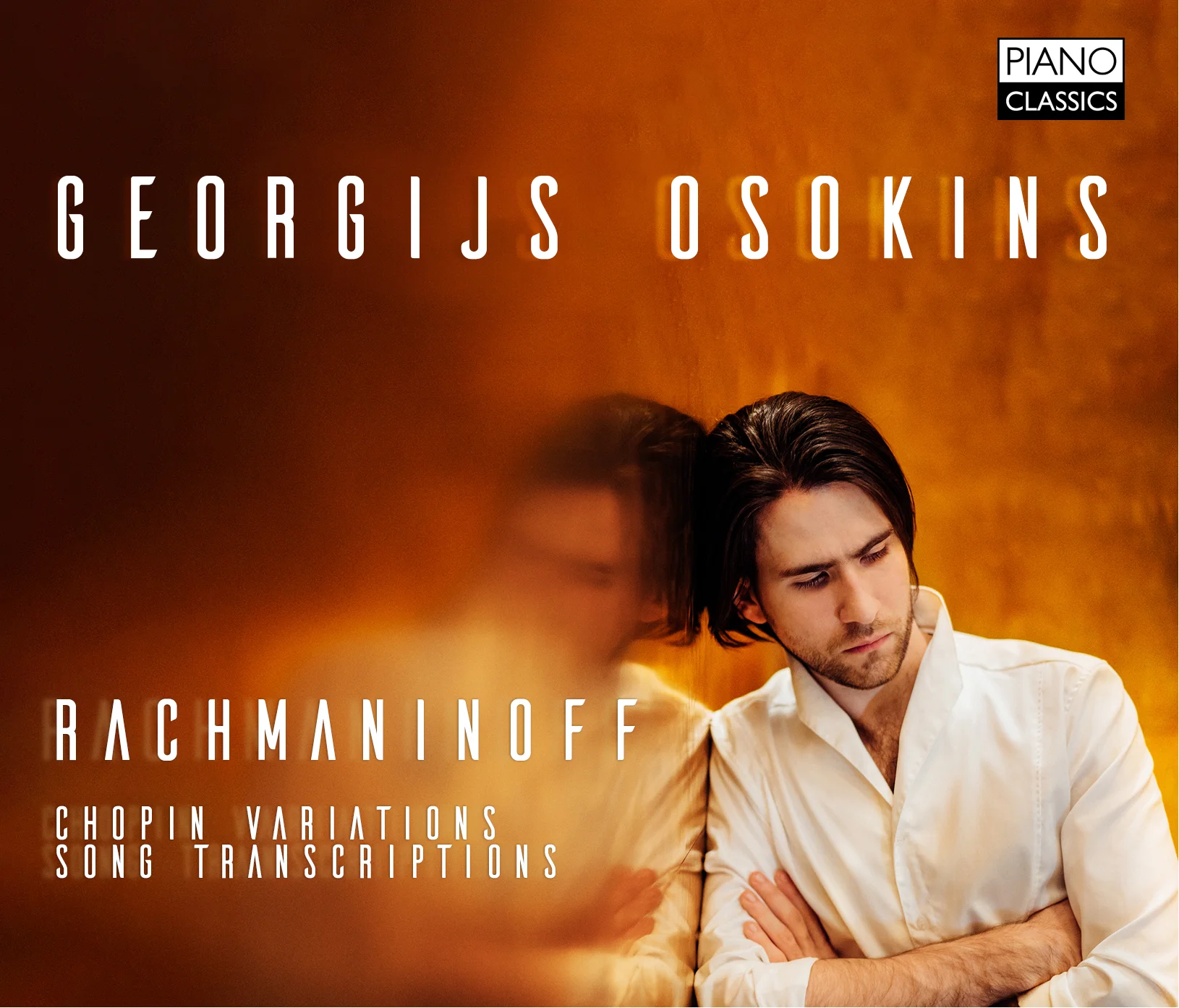
“Osokins differs strongly from the best interpreters, whether it’s Ashkenazy or Trifonov. He is more emotional, penetrates deeper into the world of Rachmaninoff and displays a particularly fine feeling for the typical Russian melancholy without ever sweetening the music.” — Remy Franck pizzicato.lu, 2019
“Osokins has a very rare gift of a true Chopinist.” — Sergei Babayan
“Osokins is a protégé of Gidon Kremer and one understands why. Refined, impeccable technique, musical ideas, simply great piano playing. He could be taken up by one of the major recording companies such as Deutsche Grammophon who would welcome it.” — France Musique
“You recreated the kind of moments I was lucky enough to hear with Horowitz at his best, a link to an earlier time — Rachmaninov, Hofmann, Friedman — artists whom my generation never heard.” — Garrick Ohlsson
“I regard this young pianist as someone close to me, highly gifted musician. He has big future. In Georgijs I see not just a remarkable pianist, but a true kindred spirit, someone deeply attuned to the spiritual core of Arvo’s music, and capable of carrying that voice forward for generations to come.” — Gidon Kremer
“You are about to hear Chopin’s Second Concerto for the hundredth time and suddenly, a pianist appears who tells you a new story, who intersperses his discourse with original touches, unprecedented accents, reveals original phrasing, and employs his own unique articulations, that are all his own and, in doing so, exalts the profound meaning of the work. All of this goes straight to your heart. Ah, how beautiful was Osokins’ Chopin in Monaco! As an encore, he unleashed a breathtaking whirlwind with Horowitz’s stunning transcription of Berlioz’s Rákóczi March. One wonders how ten fingers can play so many notes at once, across the entire keyboard! In a second encore, he conveyed the delicate touch of a Strauss Lied. This pianist moves us as much as he dazzles us.” — André Peyregne, Résonances Lyriques
“As a rule it probably holds: one must play everything as simply as possible — plain, without frills, without laying it on thick. This applies even to seemingly complicated, nervous musicians like Horowitz and the like, who in reality also stayed plain and on the line. Georgijs Osokins does this here too — in the form of consummate composure and simplicity. The art lies in holding back as much as possible and still finding an expression within it — all the more so, of course, in the earlier, more agitated pieces.” — Kai Luehrs-Kaiser, radio3 / rbb, 12/2025
“This young musician is exceptionally talented.” — Dmitri Bashkirov
“What is immediately striking about Osokins is the tremendous range of his crystalline, highly distilled and fairy-tale-like sensitive touch and his sense of musical timing. The contrasts that reveal this are abundant to marvel at and lose oneself in… The most versatile and musically loving album for the Pärt Year 2025. With this album, Osokins catapults himself into the very front row of pianistic alchemists.” — Online Merker
“Opening with the world premiere of Osokins’ own transcription of the mystical, deeply spiritual and deceptively translucent “Fratres” together with “Für Alina”, the measured fermate and extended pauses were as meaningful as the hypnotic, upper register notes which provide the detached cantilena… A touchingly poetic, almost Brendel-esque reading of Schubert’s Moments Musicaux… Osokins dazzled with insightful interpretations of Pärt and a much broader showcase of pianistic virtuosity.” — Slippedisc
“In his hands, shifting textures and colors emerge, melding into gentle sonorous landscapes. Such an approach requires extraordinary sensitivity in pedaling, an art Osokins demonstrates with particular mastery…” — Concerti
“Georgijs Osokins arguably delivered up the day’s most strikingly individual interpretations. He won me over with his concentration and control of minute details, such as the long chains of carefully calibrated trills. Indeed, his epic sense of time scale is akin to Emil Gilels.” — Gramophone, during the Chopin Competition
“Osokins caused something of a sensation at the 2015 Warsaw Chopin Competition” — Harriet Smith, Gramophone
“Osokins is right at home in this repertoire, having caused something of a stir at the 2015 Warsaw Chopin Competition, and he certainly has the requisite mix of agility and grace demanded by the first movement, with the two string players well matched in the recorded balance.” — Harriet Smith, Gramophone Magazine, January 2021
“Kombiniert mit so vielen Aha-Momenten wirkte das 1. Klavierkonzert von Schostakowitsch fast berechenbar brav. Als Solist war der junge lettische Pianist Georgijs Osokins gerade deswegen eine sinnige und stimmige Wahl, denn nachdem der sich auf einen arg niedrigen Klavierhocker gefaltet hatte, fand er eine gut funktionierende Balance zwischen den virtuosen Abschnitten und den Anspielungen auf spätromantische Brillanz und berühmte Vorbilder.” — Hamburger Abendblatt, after Georgijs’ debut at Elbphilharmonie, 2019.
“Die herausragende Interpretation des Abends ist das Konzert für Klavier, Trompete und Streichorchester von Dmitri Schostakowitsch. Sergei Nakariakov mischt sich mit seiner Trompete unter die Geiger und überlässt dem 24jährigen Georgijs Osokins die Bühne, der bereits 2015 beim Internationalen Chopin-Wettbewerb in Warschau 19 jährig für Aufsehen sorgte. Osokins Spiel beflügelt, die spürbare Freude an der Musik ist auch der jungen Kremerata Baltica anzusehen.” — klassik-begeistert.de by Elzbieta Rydz, after Georgijs’ debut at Elbphilharmonie, 2019.
“Eine eminente Begabung für die Musik Rachmaninows. Es fasst sie durchhörbar, federnd elegant und nie fett oder überpedalisiert, was der dichten Textur eines viel zu selten gehörten Opus’ wie den Chopin-Variationen sehr entgegenkommt. Unter Osokins Händen wirkt die Fülle des Satzes fast schlicht und angemessen.” — Matthias Kornemann, Fono Forum Magazine.
“Die bahnbrechende Erscheinung des Abends war aber Osokins. Seine Chopin-Interpretation ist aufsehenerregend. Kein glattpolierter Klang, sondern Kanten und Rhythmik in den Mazurken. Zwei Chopin-Etüden bringen diese Genialität auf den Punkt: Klangarchitektur exquisit, wie aus dem Moment gemeißelt, die ‘Revolutionsetüde’ in beängstigender Dämonie.” — Oberösterreichische Nachrichten, Austria 2020
“Georgijs Osokins, avec cette alliance surprenante de bravoure et de gravité, avec cette sonorité si rare qui s’unifie autour du bas medium, phrase Chopin ample, tend son discours, et propose souvent des lectures radicales qui étonnent : écoutez seulement la conduite absolument originale qu’il imprime à la si complexe Polonaise-fantaisie, une longue divagation qui pourtant n’oublie pas la forme qui l’autorise. C’était oser beaucoup pour un premier disque Chopin d’aller uniquement aux ultimes opus. Mais que ce soit dans la Sonate en si, dans la si noire Berceuse, dans les Mazurkas de l’opus 59 dont il fait trois mondes en soi, ou dans cette Barcarolle dés le premier accord captivante, tragique plutôt que rêveuse, il affirme avant même que des moyens somptueux des conceptions altières et pourtant murement réfléchies qu’on n’attend pas d’un pianiste si jeune. Et si un futur Grand traçait là ses premiers sillons? Ecoutez seulement.” — Discophilia Artalinna.com Jean-Charles Hoffelé
“Lapping up its virtuoso frills alongside the parades of ringing chords, Osokins had the work’s full measure. The others pitched in at a similarly high level. From the cello came formidable warmth, while Kremer darted in and out with the glee and precision of a born collaborator, happy to be making wonderful music even in dark times, on a dreadfully wet night.” — Ben Reason, thetimes.co.uk
“Osokins’ CD-Debüt erweist sich als eine der persönlichsten, gleichsam eine der schlüssigsten und spannendsten Chopin-Veröffentlichungen der letzten Jahre.” — Leidenschaft für Musik, www.jpc.de
“A pianist of this individual stamp (and Daniil Trifonov, Evgeni Bozhanov, Benjamin Grosvenor, Federico Colli and Ivo Pogorelich before them) presents the listener with a conundrum. He raises all sorts of issues concerning fidelity to the score and the limits of interpretation.” — Michael Moran, Australian music critic.